Five steps in developing and implementing
There are five steps in developing and implementing the value proposition
Choose target group
1 Determine the ‘area of opportunity’ based on insights
- Market insights
- Customer insights
- Business insights
2 Develop value proposition
- Customer insights & needs
- Promise
- Benefits
- Evidence
3 Develop specific offer
4 Set up requirements for implementation
Impact on e.g. distribution, processes, people
5 Test and implement proposition
1 Determining the area of opportunity based on insights
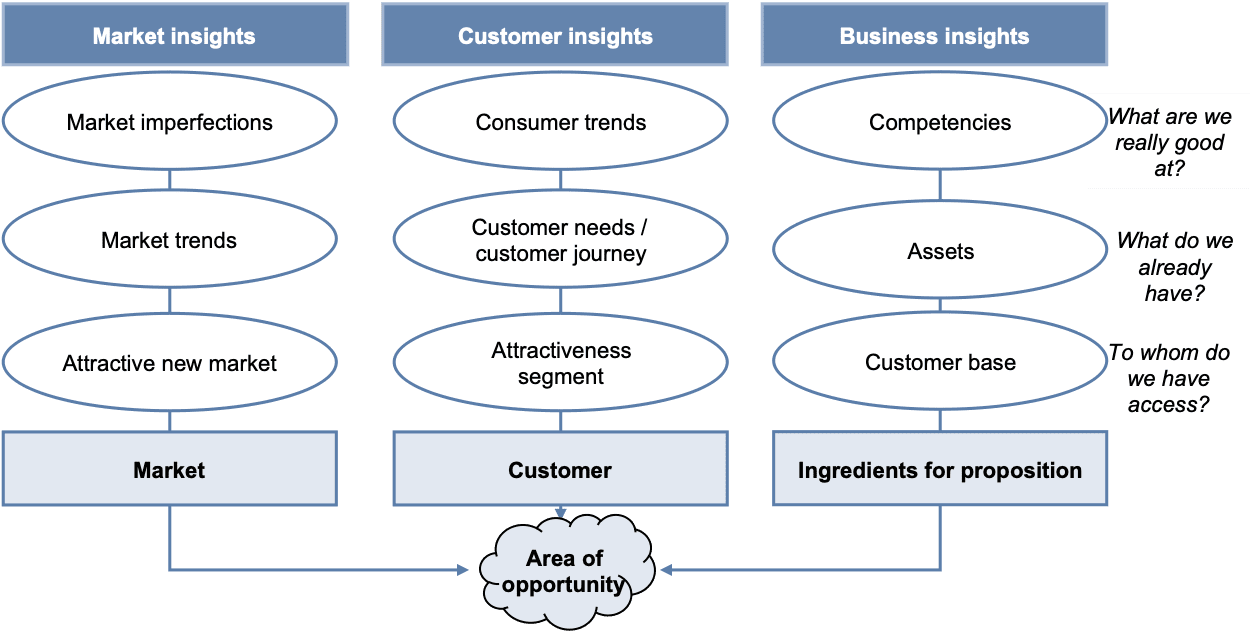
Insights are key in developing the value proposition. Insights can be collected and gathered via various ways. The most often used methods are described below:
Market insights:
- Market reports of government or other organisations
- Desk research
Business insights
- Management dashboard
- Business / market intelligence data
Customer insights
- Trends and development reports of government, consultancy firms or other organisations
- Research performed by organisations
- Focus group / interview.
Market insights
Describe the market in aspects of
- Market development and potential
- Developments and trends
- Breakdown of market in segments
- Relevant competition or key market players
Customer insights
Describe the customer in aspects of
- Profile (age, gender, workstatus, marital status, lifestyle, religion etc)
- Choice and orientationprocess
- Product needs
- Image / perception of company and competitors
- Value of product to consumer and usage
- Market imperfections from customer perspective
Business insights
Describe the business in aspects of
- Assets, strenghts and competencies that can be used
- Insights in customerbase
- Product / service inflow and outflow
- Sales funnel: from lead to conversion
- Internal perception of products and services.
2 Develop the value proposition
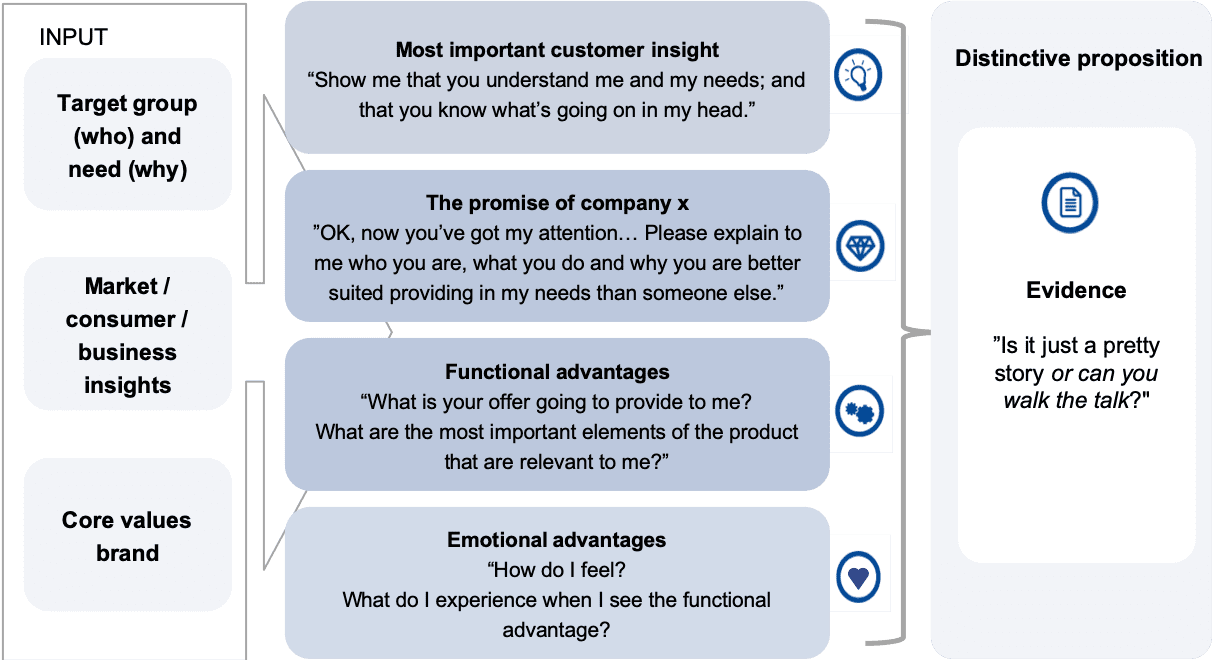
Once the organisation chooses its target group and collects market/consumer/business insights it is time to develop the value proposition. If relevant, the core values of the company and/or brand can be used as input as well. To develop a value proposition there are a few steps:
- Determine the most important customer insight: What are the main customer trends & developments? Translate the customer insights to the customer need / problem: What keeps the customer awake at night?
- Develop the promise of the organisation: What do we promise to our customers that differentiates us from our competitors
- Define the functional advantages: Which features can be perceived as benefits
Define the emotional advantages: What are the self expressed benefits of our products /services? - Define the evidence: What is the proof that we deliver our products / services and promises?
3 Develop specific offer
An offer is the logical result of the value proposition. It is the actual product or service an organisation proposes to the customer with which their need will be served or problem solved. Besides the product or service itself, the offer includes the price and if relevant contract options.
The offer is the logical result of the customer need and promise. By purchasing the offer the customer will experience the promise. It is essential that the offer is the best the company can deliver to the customer in terms of solving their problem and serving their needs. For example, offering a $500 smartphone to a student will probably solve his problem of not being connected 24/7 but will not meet his need of low budget solution.
Triggering questions
Which products and services do we provide for which costs?
- Are there any special packages?
- Is this offer serving the customer need / solving the problem?
- Is this offer the best solution for the customer?
4 Set up requirements for implementation
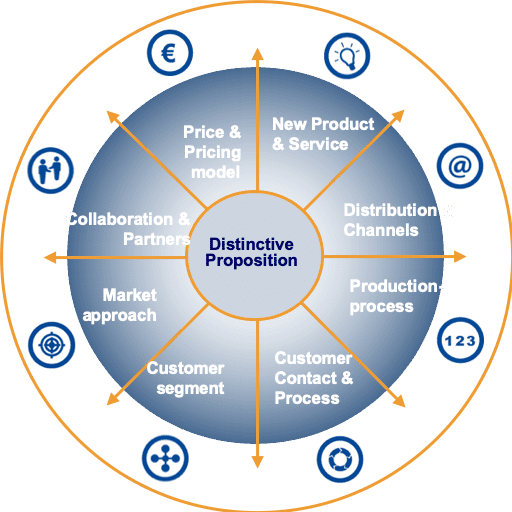
The target group is selected and value proposition defined. The next step is to determine the impact of the proposition on other elements of the organisation. Solely developing a string value proposition will not inevitably lead to success. A strong proposition is differentiating itself in multiple areas. It is key that the entire organisation is aligned with the (new) proposition. The figure below shows the main areas that need to be aligned with the proposition.
5 Test and implement proposition
The final steps is to test the proposition with (potential) customers. This can be done via a survey, interview or focus group. Also challenging it with other colleagues will lead to better results and on top engaged colleagues.