Business model canvas – Osterwalder
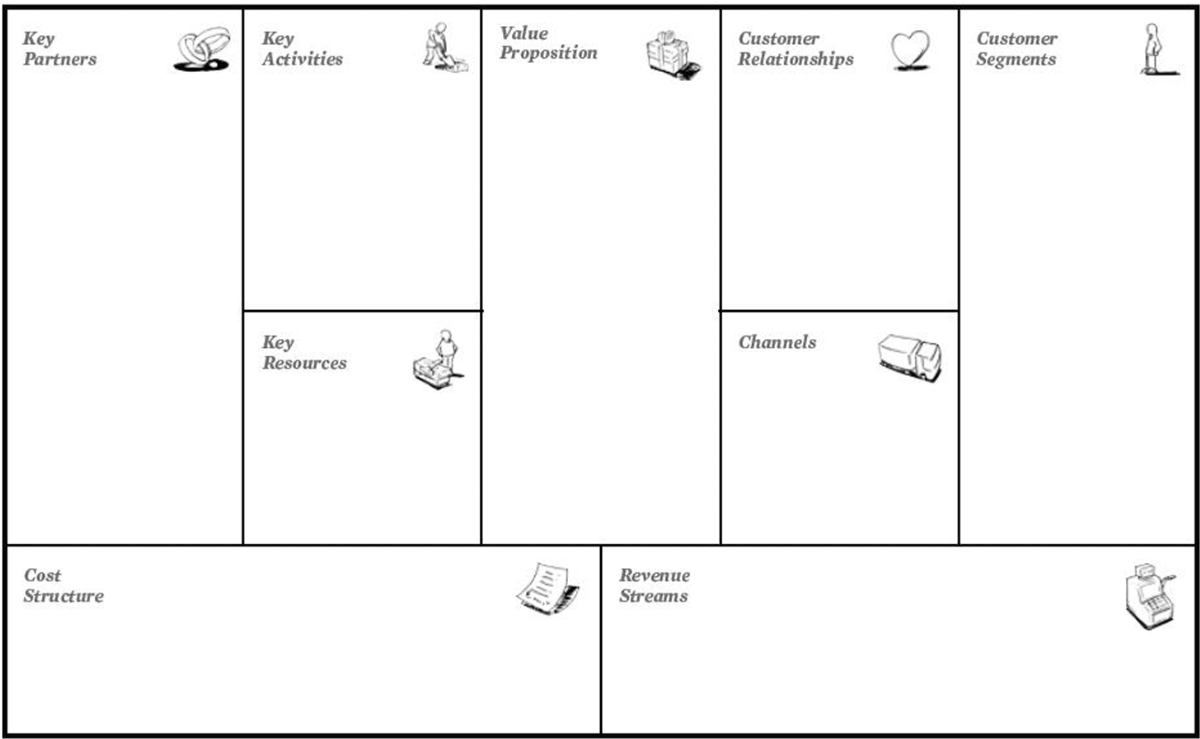
Formal descriptions of the business become building blocks for its activities. By using the business model design template of Osterwalder an enterprise can easily describe their business model, based on 4 elements: Offering, Infrastructure, Customers and Finance. We will take a closer look of the elements.
Offering
Value propositions – A company’s value proposition is what distinguishes itself from its competitors. Value propositions may be quantitative (price and efficiency) and/or qualitative (overall customer experience and outcome).
Infrastructure
- Key activities – Most important activities in executing a company’s value proposition.
- Key resources – The resources that are necessary to create value for the customer. May be human, financial, physical and intellectual
- Partner network – Both to optimize operations and reduce risks of a business model, business alliances are being considered to enable focus on core activities
Customers
Customer Segments
An effective business model identifies which customers to serve. There are several options such as serving mass market, niche market, serving diversified markets (different needs and characteristics), multi-sided markets (mutually dependent customer segments)
Channels
Companies can deliver value propositions to targeted customers through different channels. Effective channels will distribute a company’s value proposition in ways that are fast, efficient and cost effective.
Customer Relationships – Companies need to identify the type of relationship they want to create. Types of customer relationships include: co-creation (development with customer input), communities (platform where knowledge can be shared and problems can be solved), self service (making customers independent), personal assistance (customers communicate directly with company representatives)
Finances
A value proposition can be developed for different levels: organisation, label or product. The first step for an organisation is to determine the level. The proposition can be conveyed via e.g. promise, solution to a problem or commercial slogan.
Cost structure
A company can be driven by costs or value. In the cost-driven business model companies focus on minimizing all costs whereas in a value-driven business model companies are focused on creating value for their products and services.
Revenue streams
There are several ways of generating revenue streams. Possible options are:
- Asset sale: trade of (physical) ownership
- Usage Fee: revenue generated from the use of particular services
- Subscription fees: revenue generated by selling continuous service
- Licensing: revenue generated from charging for the use of a protected intellectual property
- Brokerage fees: intermediate service between two parties
- Advertising: revenue generated from charging fees for product advertising
Value Proposition
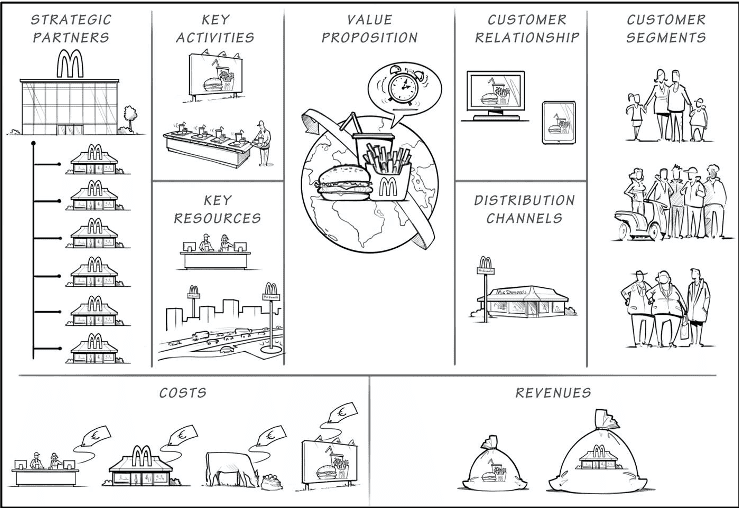
Food of constant quality that is served quickly and consistently across the globe
Customer Segments
Families, youngsters, elderly and business people
Strategic Partners
Franchise holders and suppliers
Key Activities
Marketing and selling food and beverages
Key Resources
Company’s employees and A-location restaurants
Customer Relationship
Takes place online on the device preferred by customer
Distribution Channels
Through restaurants
Cost Structure
Employees, restaurant, raw materials and marketing
Revenue Streams
Generated at restaurants