
Contribution of business models
A business model describes the value an organisation offers to various customers and portrays the capabilities and partners required for creating, marketing and delivering this value and relationship capital with the goal of generating profitable and sustainable revenue streams.
Often business models are being confused with business cases. Business cases provide an funded reasoning on how the company creates value in terms of money, business models on the other side are broader and describe all factors which influence the value creation.
By using the so-called business model canvas relationships between the value creation factors can be mapped.
Keywords: Business Models, Value Creation, Business Model Canvas
According to “Dr. Business Model” Alex Osterwalder the definition of a business model is:
“the value an organisation offers to various customers and portrays the capabilities and partners required for creating, marketing and delivering this value and relationship capital with the goal of generating profitable and sustainable revenue streams”
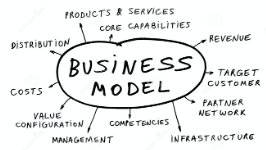
Value propositions
The proposition of the company, both in product as in service, expressed in value for the customer
Target customer
Description of the customer or customer groups which are being targeted, with their specific characteristics
Distribution channels
The way the company contacts clients, also describes marketing and distribution strategy
Customer Relationships
Managing the relationship between company and customer or customer groups
Value configurations
The configuration of activities and resources
Core capabilities
The main competencies which are required of executing the business model
Partner Network
Collaborations with other companies which influences the success of the business model
Cost structure
The monetary consequences of the means employed in the business model
Revenue model
The way the company creates value; revenue generation
Core of your business – current and new possibilities
A business model describes the rationale of how an organisation creates, delivers and captures value, in economic, social, cultural or in other contexts. It consists of the value proposition (the added value for customers), value architecture (organisational infrastructure), value finance (the economical streams) and value network (which stakeholders are involved). In other words: business cases provide a funded reasoning on how the company creates value in terms of money, business models on the other side are broader and describe all factors which influence the value creation.
Business models can be used to describe and classify businesses and to explore possibilities for future development.
In this module we will take a closer look at how to design business models, taking the various factors into account.
There are several models available for business modelling. In this chapter we indicate some models. In the next lesson we explain more about the application.